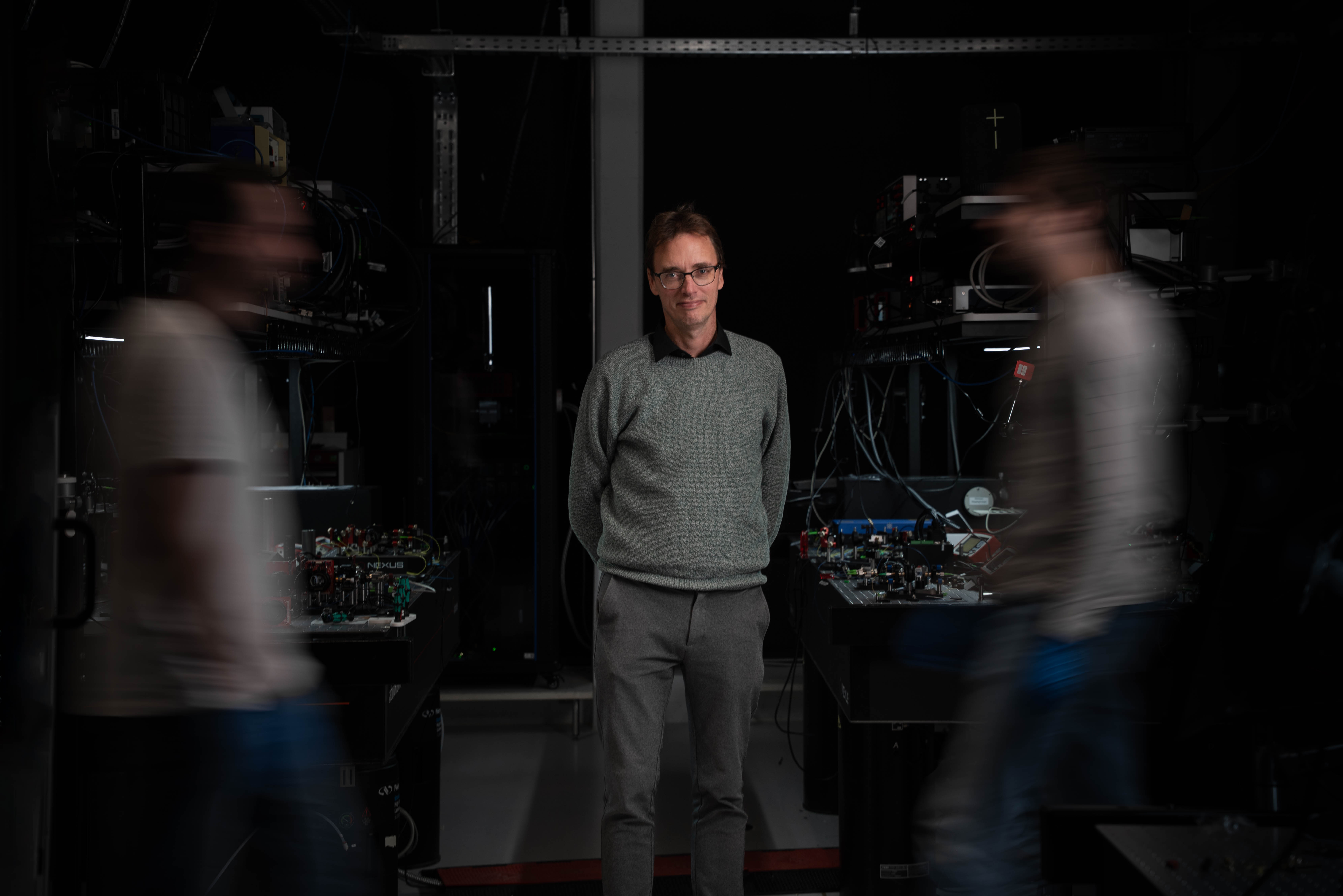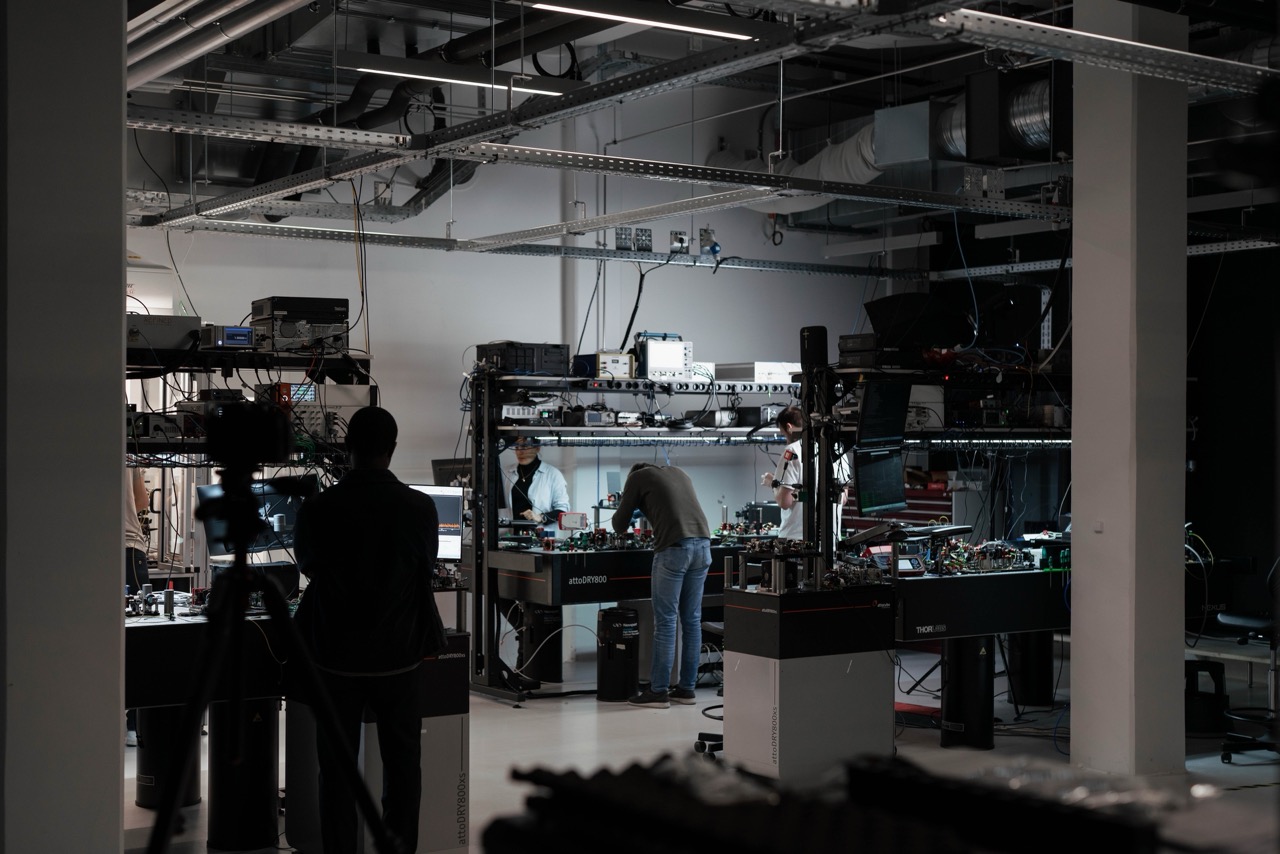

A spin-off from the Niels Bohr Institute at the University of Copenhagen, the company was established a decade ago, and started commercial R&D and operations in 2020. It recently announced $35M in Series A funding, with participation from Denmark-based North Ventures, Scale Capital, and Jacob Jakobsen Gruppen ApS, LIFTT EuroInvest (European Investment Bank) and LIFTT, an Italian venture capital firm. This augments a seed funding round of $25M in April 2025, and a recent announcement of Sparrow leading the €50M European Photonics for Quantum (P4Q) pilot line for semiconductor processing and standards development. Dr. Peter Lodahl, Sparrow’s co-founder and CQO (Chief Quantum Officer) is on P4Q’s executive board.
Dr. Lodahl was a Professor at the Niels Bohr Institute, and currently works full-time as a Sparrow (this is what the company’s employees are affectionately called). There are more than 50 Sparrows working to move quantum technology forward, specifically in the area of single photon semiconductor sources. It turns out that ordinary lasers used for communications, sensing and materials processing cannot produce a single photon reliably, on demand, a capability is critical for using a photon as a qubit or a carrier of quantum information. Per Dr. Lodahl, doing this in a scalable way paves the path for realizing reliable quantum computers.
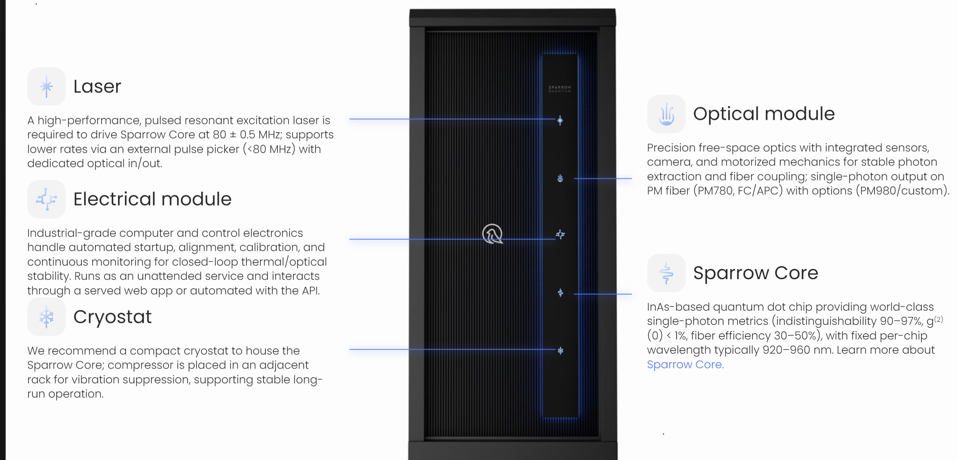
Sparrow designs and fabricates single photon laser sources using quantum dot expertise developed at the Niels Bohr Institute. It involves heterogenous deposition of epitaxial GaAs (Gallium Arsenide) material on waveguides in SiN (Silicon Nitride) wafers which are then processed using classical techniques used manufacture standard lasers. The epitaxial growth and deposition in SiN is done in Sparrow’s fabrication facilities in Copenhagen, Denmark. The Sparrow Core is the heart of the single photon source. The integrated 3 × 3 mm chip is made from indium arsenide/gallium arsenide quantum dot structures embedded in photonic crystal waveguides, sectioned into an array of structures engineered for emitting highly coherent single photons at specific wavelengths between 920 and 980 nm. Efforts are also underway to produce sources emitting at 1310 nm to support fiber-optics communications.
Figure 3 shows the Sparrow Nest, the company’s integrated chip and rack-mounted single photon emitter product.
Dr. Lodahl believes "that the EU has outstanding talents and a burgeoning awareness that we cannot afford to miss the opportunity in quantum, and we can build agile and truly collaborative teams which is essential to be competitive in this arena. We need to make bets in areas where EU has a true competitive leadership – quantum photonics is such an area. The EU does win gold medals at the Olympics but not in all disciplines at once!”
Read the full article here.